
- roberturquhart37
- Jan 7
- 4 min read
Dear Friends, Battleships!
Trump wants battleships and he wants to name them after himself. This is appropriate in a way. He and they are in some ways similar, bloated lumbering things that can do huge damage but not for any real purpose. Apart from this it’s an amazingly stupid idea, though here again, it’s an epitome of Trumpism in all its stupidity and ignorance.
So, battleships, what are they, where did they come from, where did they go?
The Influence of Sea Power upon History, 1660-1783 (1890) by Alfred Thayer Mahan did not invent the battleship, but it established the two principles that made it the core of naval strategy.
First, the decisive battle, the confrontation of the entire national fleet with the national fleet of the enemy. Decisive victory in the battle is understood to translate into victory in the war.
Second, the vessel that will win the decisive battle, the capital ship. And victory in the decisive battle requires that the capital ship be ever larger, and ever more heavily armed. The capital ship fully realised is the battleship.
And the battleship is the Dreadnought, launched by King Edward VII, 10 February 1906, “the ship that made all existing navies obsolete”, and whose mighty career, before being sold for scrap in 1921, consisted in ramming and sinking a German U-boat in Pentland Firth, 18 March 1915. Nonetheless the Dreadnought was the father of all later battleships beginning with the entire Dreadnought Class – yes, I know, ships are usually considered female, but I wouldn’t want to tell the Dreadnought that, it did rather present itself as stunningly male.
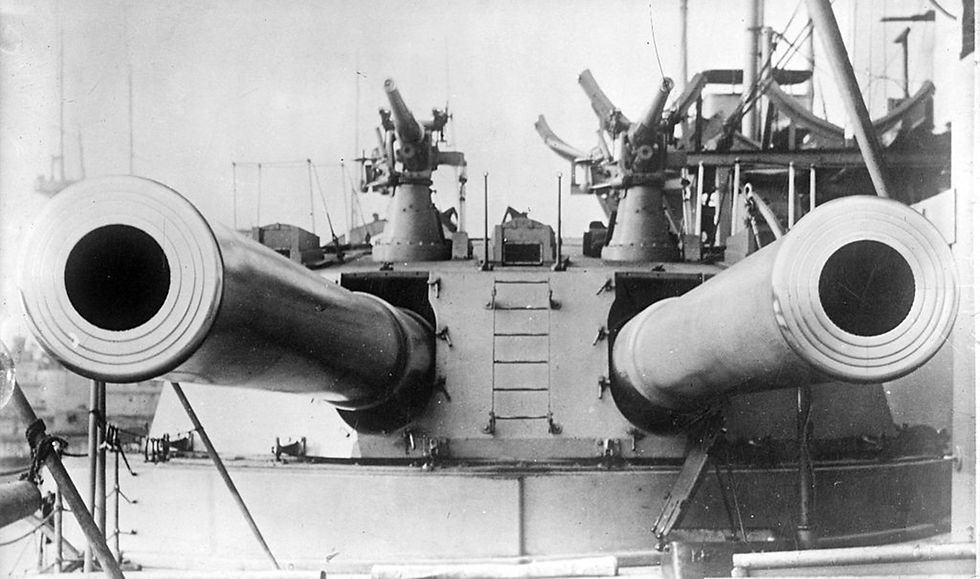
And what did the mighty Dreadnoughts do? Mostly they sat around in harbour. But they did have one grand day out. In 1916 the British and German Grand Fleets sailed out to meet one another for the decisive battle, and they did actually meet, although they also spent quite a lot of time trying to avoid each other, off the Jutland Peninsula in the North Sea 31 May – 1 June 1916. They banged away at each other for a day and a night and then decided to call the whole thing off. Both sides suffered heavy losses, though the British losses were much worse. Both sides claimed victory, but the British could be said to have scored a sort of tko, since the German fleet returned to port and stayed there for the rest of the war.
And what did the decisive battle achieve? Nothing. Oh, except that the German Imperial Fleet stayed put, and turned naval warfare over to where it belonged, to the U-boats, and they really did do something.
For that 6,094 British and 2,551 Germans died.
Jutland is one of precisely two battles in which two fleets of modern battleships confronted one another. The other is the Battle of Tsushima Strait (27-28 May 1905) which brought the Russ0-Japanese War to an end. It truly was a decisive battle, it was also a foregone conclusion. The Japanese defeated the Russians at sea, they had already defeated them on land.
The real naval struggle in the First World War was the battle for the convoys. In the Second World War there were various battleship shenanigans – Sink the Bismarck! – the real war in the Atlantic was once again for the convoys. The convoys needed fast maneuverable ships, destroyers and cruisers, to defend them, not lumbering great battleships.
The Pacific theater created a genuinely new form of naval warfare, the battle between enemy aircraft carrier task forces, where the carriers depended on their own aircraft and destroyers and cruisers to defend against enemy aircraft. The fleets themselves never met, battleships were irrelevant. Genuinely new, yes, but just one time. Aircraft carriers still play some sort of role, but as support.
Yes, some sort of role, but the war in Ukraine has put pretty much all existing weapons and weapon systems on notice, pink slips any day now. You can’t expect Trump or Hegseth or Republicans in general to have the faintest idea about this, presumably there are people in the Pentagon who do, though I imagine they’re keeping their heads down. So: it’s unclear that surface warships, fighter planes and tanks have any real future, bombers are long gone. Certainly fighter plane rocket strikes work well if you are bombing a defenceless enemy (an enemy with no air force or significant anti-aircraft weapons), you can reduce an entire territory to rubble with very little danger. Russian fighters have been a lot more cautious than those of the IDF.
Tactical (battlefield) air support is now mostly drones and self-navigating missiles. Strategic (terror) bombing is also now by missiles rather than the British and American strategic bombers of the Second World War, of Cambodia, Laos and Vietnam. It would be a happy day to see the last B-52 melted down for scrap only that the missiles can do worse, and they do.
What’s left? The infantry, grunts, tommies, poilus. War began with bands of men on foot attacking one another with anything that came to hand, it seems that it will end in much the same way, except that the men, friend and foe, will face each other under a barrage of weapons controlled a safe distance away from the battlefield.
Trump, who thinks he’s such a great snake-oil salesman is a perfect mark for the pros. Hey guys, you know to put a lot of gold in the captain’s quarters, right? Just checking. But maybe there’s a bright side: spending billions on useless weaponry is stupid; the billions could be spent on valuable things – schools, hospitals, infrastructure. Still spending billions is still spending billions, it increases aggregate demand. Keynes, in the 1930s said that of course it would be better for the government to spend money on socially valuable projects, but if they won’t do that, it would still be a lot better than nothing for them to bury a lot of money across the countryside and leave it to private individuals to find it and dig it up. The Trump battleships are very unlikely ever to see their keels set to breakers forth on the godly sea, and a good thing to. But spending is spending, and spending on weaponry that never will be used is an added bonus. Of course, never will be used is the necessary condition.
Love and solidarity,
Bobby